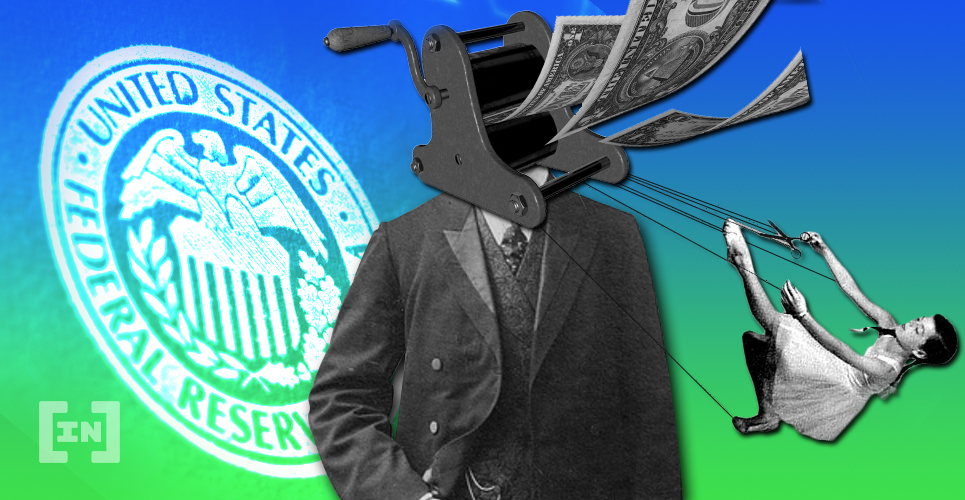
It took the sudden emergence of a pandemic to demonstrate how pathetic the global financial system really is. The US Federal Reserve (Fed) is now doing a live demonstration on how to print money out of thin air and buy government and corporate securities with it. It seems that Plan B’s model will work indeed.
US Central Bank Pumps $1 Million Per Second
The US financial system showed the first signs of a crack well before the COVID-19 was even a thing. In September last year, the Fed started to pump money to control the overnight general collateral repo rate, which surged over 1% at the time. The central bank said it was only a temporary measure to bring the repo rate closer to its low interest rate, but it has continued those operations to this day.
Moreover, the major crisis caused by the coronavirus outbreak has forced the US government and the Fed to take unprecedented measures to save the economy. What is happening right now will be in history books.
The Fed has implemented the following measures to inject money into the economy:
It has cut the interest to zero, though the same tactic was used after the financial crisis in 2008.
It has bought unlimited amounts of government bonds and mortgage-backed securities. This is the first time in history that the Fed has pledged unlimited stimulus.
The Fed announced it would start buying municipal bonds.
For the first time ever, the Fed said it would purchase corporate bonds.
Bazooka is not even a term to describe the massive pile of money the Fed is creating right now to buy everything. It seems that the central bank has the capability to move on to purchase company stocks and even make direct transfers to individuals.
The Fed’s balance sheet is now at a record $5.3 trillion.
One million dollars every second.
That's how much the Federal Reserve is printing.
It's balance sheet increased by $586.1 billion last week to a record total of $5.24 trillion. Which is $84 billion a day and $60 million printed per minute.
— Vis (@Vis_in_numeris) March 27, 2020
To clarify, what the Fed is doing right now is issuing cash out of thin air and buying government and corporate IOUs.
Fed Moves On to Buys Bonds from Abroad, May Buy Stocks As Well
Another day, another “emergency lending program” is created by the Fed. Now the private entity wants to pump money on a global scale. A few hours ago, the US central bank said that it launched a “temporary repurchase agreement facility aimed at international monetary authorities (FIMA Repo Facility).”
In other words, the Fed will create money to buy US Treasury securities from central banks and other monetary authorities, which can use the US dollars in their jurisdictions.
At home, economists argue that the Fed might intervene in the stock market for the first time. However, the central bank would need permission from the US Congress.
Quincy Krosby, chief market strategist at Prudential Financial, commented:
If there were any major dislocations, it is clear that they will go into whatever nook and cranny in the market that starts to choke. We know that when you have choking in one part of the market, you have choking in another part of the market that leads to dislocation. As soon as you cross that line, you are now facing something else that you could conceivably buy.
It’s funny how JPMorgan CEO Jamie Dimon said three years ago that:
You can’t have a business where people can invent a currency out of thin air and think the people buying it are really smart. It’s worse than tulip bulbs, OK?…It’ll eventually blow up. It’s a fraud, OK?
He was speaking about Bitcoin, but why wouldn’t he apply this to the US dollar? The latter is becoming a major bubble right now. While the Fed’s emergency measures might reduce short-term damage, it only fuels the America’s long-term problems.
It’s Not Only About Fed, US Government Is Involved As Well
If you think the US government will handle the bubble, you are wrong. The Fed has been regarded as a private entity that has not been ruled by any government entity. However, judging by the credit and funding facilities it just launched, it means that it collaborates with the US Treasury simply because the Fed doesn’t have permission to buy corporate bonds, stocks, and municipality bonds. Does it mean that it is taking over the US government or vice versa?
In an old interview, former Fed chief Alan Greenspan said:
First of all, the Federal Reserve is an independent agency, and that means basically that there is no other agency of government which can overrule actions that we take.
Despite everything, the Fed is now working in tandem with the US government. Specifically, the central bank will finance a so-called special purpose vehicle (SPV) for each of its credit operations (of buying government bonds, corporate bonds, commercial paper, etc.). The US Treasury will make an equity investment in each SPV through the Exchange Stabilization Fund, effectively buying all these securities. The Fed is only acting as banker, offering financing. It recently hired BlackRock to buy all securities and manage the SPVs on behalf of the Treasury.
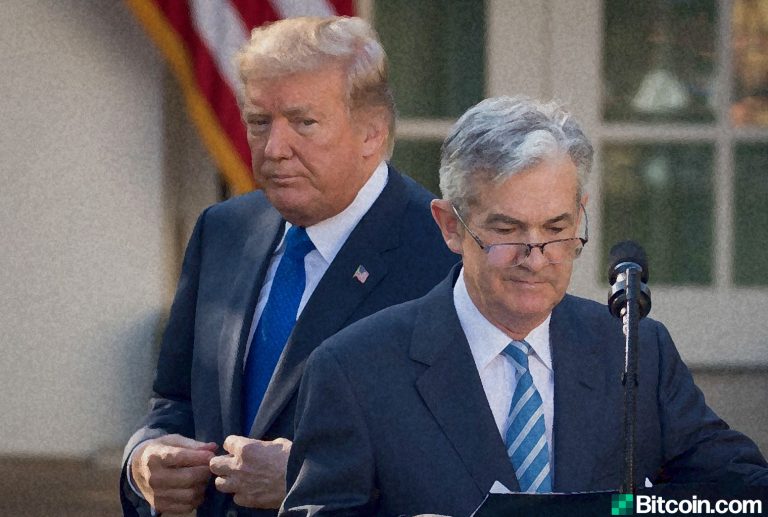
It means that the US government is nationalizing the financial markets. This scheme merges the Fed and Treasury into one organization, at least for now. Thus, the printing press is in the hands of US President Donald Trump, and who can guarantee that he doesn’t use it after the pandemic is gone?
The crypto market will boom in the coming years because the Fed is pumping unlimited cash right now.
Do you think the injection of liquidity will boost Bitcoin? Share your thoughts in the comments section!
Images via Shutterstock, Twitter: @Vis_in_numeris, digitalik.net origin »
The Federal Reserve should stay the hell away from the stock market. Need proof? Just look at its mortgage bond-buying fiasco.
The post This Is Why the Fed Should Stay the Hell Out of the Stock Market appeared first on CCN.com
Unless you have your head in the sand, you’ve probably realized that governments and central banks can print money out of thin air and in unlimited amounts. The United States and the Federal Reserve have been creating money from nothing for years because they had exhausted all their monetary policies.
The Federal Reserve just rolled out the biggest weapon in its arsenal, but the stock market barely blinked. The Fed has run out of ammo.
The post It’s Official: The Federal Reserve Just Shot its Bazooka – And Failed appeared first on CCN.com
Whatever it takes, has been the message of politicians across the world, more red, has been the response of stock markets. A give away of $1,000 to every American, a...
The post World Braces For Great Depression as Fed and Gov Run Out of Ammo appeared first on Trustnodes.
Recent actions by the Federal Reserve leave many people wondering what the future will bring. One thing is certain: banks will never officially run out of money, which is something Monopoly would’ve taught everyone.
The Dow Jones surged after the Fed's first emergency rate cut since the financial crisis. Here's why the stock market rally suddenly fizzled.
The post This Is Why the Dow Jones’ Fed-Fueled Surge Suddenly Fizzled Out appeared first on CCN.com
In a reversal of previous policy, Fed Chairman Jerome Powell has come out in favor of anonymous cryptocurrencies in his recent comments to the House of Representatives Committee on Financial Services.
The U.S. housing market is reportedly worth $35 trillion, but the Fed could knock the wind out of its sales with more rate cuts.
The post Is the Fed About to Trigger the $35 Trillion U.S. Housing Market Crash? appeared first on CCN.com
The US central bank’s effort to expand its balance sheet through a pseudo-quantitative easing program could prompt bitcoin to pursue its next bull run. Since October, the Federal Reserve has been buying $60 billion worth of T-bills every month.
Since mid-September, the Federal Reserve has injected three trillion U. S. dollars into the hands of private banks and Wall Street. Despite the fact that massive amounts of money was created out of thin air, the central bank still believes repurchase agreements (repos) are needed to tame the turbulent economy.
With the potential for an economic crisis intensifying, global central bankers are having to work overtime to ensure some stability. This has led to the Federal Reserve stepping in to add $111. 9 billion to the financial markets to help with liquidity.
The Dow turned lower on Wednesday after the tariff rollback hype began to fizzle out. Inflation came in close to expectations, making it unlikely that the Fed will stray from its neutral stance. One analyst warns that the stock market rally is being fueled by a dangerous catalyst: FOMO.
2019 saw the adoption of blockchain go through the roof, with many global economies figuring out regulations and announcing their own centrally-backed digital currencies. However, according to former The post Central bank-issued digital currency not required: Former Fed Chairman appeared first on AMBCrypto.
Stephen Moore, Trump’s initial nominee for the post of Federal Reserve Chairman and close campaign advisor, has announced his latest venture – Frax – that runs a U. S. dollar stablecoin.
The US Federal Reserve has continued its streak of quantitative easing, by pouring in funds to uphold the confidence that liquidity won’t dry out. The latest sum, $104 billion, is almost close to Bitcoin’s loss-adjusted market valuation.
Rob Kaplan, President of the Fed Reserve in Dallas, and a former executive at Goldman Sachs is the latest to come out in support of digital currency. This comes at a time when regulators are keenly looking into how cryptocurrencies like Bitcoin and Libra might disrupt the financial systems. While speaking at an event in […]
Cryptocurrency platform Vertbase has raised eyebrows with a giveaway campaign that points out the flaws in traditional FIAT currency. “FED prints $75 billion, #GOCRYPTO” reads one of the posts.
Members of the US Congress the French Hill (R-Arkansas) and Bill Foster (D-Illinois) have recommended the Federal Reserve regarding issuing a digital version of the US dollar. In a letter addressed to the Fed, they highlighted that the country’s currency is in long term danger due to the acceptance of digital fiat currency. Sheila Bair, […]
The U. S. stock market has seen a steep pullback since early September and according to Peter Schiff, the Fed is running out of ideas. As seen in the performance of the Dow Jones, which has lost more than 1,000 points in the past month, the U.
The Dow Jones slipped as much as 300 points after an unexpectedly-miserable ISM manufacturing reading sent the closely-watched economic metric to its lowest point in 10 years. As the US stock market cringed, President Donald Trump blamed the economic woes on the Fed, further pressuring a fragile Dow.
For the third day in a row the US Federal Reserve has injected more money into the system sparking widespread fears that things are spiraling out of control. The irony is that US regulators continually harp on about crypto market manipulation when it is happening on a grand scale right under their noses.
2019 has been an incredibly important year for digital currencies. The collective cryptocurrency market broke away from the bearish winter and digital assets have again started to gain attention from various financial institutions and personalities.
Major economic oppression and manipulation by governments and central banks is what drove a band of cypherpunks to create Bitcoin a decade ago. That financial storm is worsening which has generated an even greater need for a decentralized form of money.
By CCN Markets: Dow Jones Industrial Average (DJIA) futures are on a knife-edge on Tuesday as ominous recession warnings ring out around the world. Despite the warnings, an undercurrent of trader optimism has returned to the markets as Donald Trump upped the pressure on the Federal Reserve to ease monetary policy.
South Korean Blockchain projects are ditching the domestic market due to regulatory headaches, mainstream media report. South Korean Blockchain Projects Look Abroad Referencing a range of industry experts on August 18, local news outlet Business Korea noted the increasing tendency for Blockchain projects born in South Korea to seek out easier funding overseas.
By CCN Markets: If you were hoping that the Federal Reserve would commission an urgent gathering to discuss the fate of interest rates and save the stock market, you're out of luck. James Bullard, who is at the helm of the Federal Reserve Bank of St.
The U. S Federal Reserve seems to have taken the challenge posed by cryptocurrency when it comes to faster payments. It has just announced it will be developing a faster payment system, FedNow, that will enable much faster payment between American Banks.
The Dow Jones stormed into recovery mode on Tuesday following its worst loss of the year as traders searched for - and found - a silver lining in the alarming escalation in the US-China trade war.
July was yet another strong month for the stock markets despite looming threat of a coming economic recession, with the Dow, Nasdaq, and S&P 500 all close to beating out their average monthly gains for the calendar month.
A trio of Samsung AI researchers recently developed a neural network capable of rendering photorealistic graphical scenes with a novel viewpoint from a video. In the above video we see a 3D rendering of a complex scene.
James Bullard, President of the Federal Reserve Bank of St Louis, has stated currencies are intrinsically worthless and fragile days after Donald Trump mentioned they are printed out of thin...
The post Cryptos Are Entering Global Currency Competition Says Fed appeared first on Trustnodes.
The past week has been quite eventful in the field of cryptocurrency, with the recent tweet by Donald Trump, the U.S president, on Bitcoin a cherry on top of the cake. The president of the free world lashed out at Bitcoin claiming he is “not a fan” of the digital asset and calling for regulation […]
By CCN Markets: Dow Jones futures extended losses in early trading Wednesday after Morgan Stanley cautioned investors over a possible recession. Even with Federal Reserve rate cuts on the horizon in July, Morgan Stanley equities strategist Michael Wilson warned it might be too little, too late to prevent a recession.
By CCN: Dow Jones futures carved out a spirited triple-digit rally in early trading on Tuesday as the market priced in a more dovish Federal Reserve policy. Traders now expect a series of interest rate cuts at the Fed beginning as soon as July.
Pro-Bitcoin Ron Paul Affirms That The Fed Is A Total Failure That Broke America There are not a lot of political figures which are very cherished in the crypto world. However, some figures do stand out on several occasions.
By CCN: The Dow and broader U. S. stock market tumbled on Monday, as the combination of poor economic data, geopolitical tensions and a trade-war standoff with China kept investors out of riskier assets.
Trump and other world leaders have been named and shamed in the recent Fitch ratings report. Slowing global economic growth coupled with governments’ relentless interventions are eroding central banks’ independence around the world.
Herman Cain is reportedly set to be nominated by President Donald Trump for a spot on the Federal Reserve. If appointed, the pizza chain executive’s nomination would round out Trump’s history of laughable appointments to senior positions since taking office.
On April 1, the Dow Jones demonstrated a strong short-term recovery with a 1. 27 percent increase within hours, crossing the 26,000-point mark and achieving 26,258 points for the first time since October 2018.
On Wednesday, 11 out of 17 officials at the Federal Reserve reportedly voted to not increase its benchmark interest rate, vowing to remain patient. The Dow Jones immediately responded, surging 163 points within minutes.
Even the U. S. Federal Reserve thinks Alexandria Ocasio-Cortez needs to cool it with all the money-printing schemes. CNBC reports: “An increasingly popular theory espoused by progressives that the government can continue to borrow to fund social programs such as Medicare for everyone, free college tuition and a conversion to renewable energy in the next decade is unworkable, Federal Reserve Chairman Jerome Powell said Tuesday.
In a discussion about the US Treasury Department Office of Foreign Asset Control’s addition of cryptocurrency addresses to the “no pay list,” Bitcoin speaker and celebrity Andreas Antonopoulos called the move “completely useless” and “fundamentally fascist.
This is the third instalment of reporter Colin Harper's "Living on Bitcoin" experience in San Francisco. Find out what happened to him earlier on Day 1 and on Day 2.
Former presidential candidate Ron Paul published an article titled “Trump Is Right, the Fed Is Crazy” in November 2018, pointing out for the immediate detaxation of cryptocurrencies and precious metals in the United States.
A rising interest rate environment courtesy of the Federal Reserve could hit deflationary cryptocurrencies hard, according to Robert Leshner, who spoke to Fortune about why he started a company called Compound.
Former US Congressman Ron Paul believes that tax-free cryptocurrencies may help navigate the economy past recession. Paul, the consummate libertarian and eternal critic of the Federal Reserve, believes that the abolition of crypto taxes may help avoid a crisis similar to 2008’s recession.
So they pull their uninsured money out of the banking system, disrupting the free flow of payments. […] However, suppose consumers could convert their bank deposits into a digital currency that would be issued and backed by the Fed? When it wants to raise rates — as it is doing now — it reduces its
The fight over the next chair of the Federal Reserve has drifted out of the financial pages and into everyday conversation. And in recent days, one man’s name keeps surfacing. Kevin Hassett. Kevin used to be a background character in US politics, and now he is being discussed as the person who could control the […]
Recent research from the Anthropic Fellows program is drawing attention to a shift in how decentralised finance systems may be targeted in the future. The findings show that frontier AI agents are no longer limited to spotting basic coding issues.
It’s always a bad sign when Japan makes headlines. That’s because the country used to sit quietly in the background for the majority of this century. Rates were near zero, the central bank bought almost everything in sight, and investors treated the yen as a bottomless funding source.
Asset tokenisation is beginning to change how Filipinos engage with financial products, with new research showing how the country’s digital habits are accelerating this shift. The white paper for Project Bayani: The Philippines’ Asset Tokenization Opportunity was published today by the Philippine Digital Asset Exchange (PDAX), Saison Capital, and Onigiri Capital. It outlines how tokenised […]
Alibaba is preparing to transform international business payments with a tokenised money system that could speed up B2B trade around the world. Partnering with JPMorgan, as reported by CNBC, the company will roll out a blockchain-based settlement network by December, aiming to eliminate payment delays and high transaction costs.
A new study from Bybit’s Lazarus Security Lab has unveiled a little-known truth about the inner workings of many popular blockchains: some of them have built-in tools that can freeze or block your funds.
Visa has taken a significant step toward crypto-integrated payments with the launch of a new stablecoin payout pilot in the United States. Announced at the Web Summit in Lisbon on Wednesday, the initiative allows US-based businesses to send stablecoin payouts from fiat-funded accounts directly to recipients’ crypto wallets.