Ethereum transaction fees have continued to spike as demand for smart contracts and ETH transfers have spiked.
It has reached a point where yesterday, June 6th, Ethereum miners brought in more transaction fees (in aggregate) than Bitcoin miners for the first time in months. Blockchain analytics startup Glassnode made this observation, sharing the chart below on June 7th.
“Daily Ethereum network fees surpassed Bitcoin fees yesterday. $498k vs. $308k. So far, this has only happened on 141 days (8%),” Glassnode wrote in reference to the data that can be seen below.
ETH vs. Bitcoin network fees over time chart from blockchain analytics firm Glassnode, shared on June 7th.
There are a few reasons for the high transaction fees: 1) the demand to send ETH between exchanges has increased as volatility has hit cryptocurrencies, 2) Ethereum-based Ponzi schemes are gaining popularity again, and 3) stablecoins have continued to see mass adoption by crypto traders.
Analysts say that this trend of rapidly increasing transaction fees has a number of implications for Ethereum, of both the positive and negative varieties.
It’s a Bullish Trend for Ethereum, Analysts Say
Analysts say that the increasing usage of the Ethereum network is a positive catalyst for the price of ETH.
The founder of Mythos Capital, Ryan Sean Adams, recently noted that his analysis has found that the price of ETH has been closely correlated with the transaction fees Ethereum users pay over the past four years.
If the historical relationship holds, ETH is poised to rally dozens of percent, a chart from Adams shows.
ETH Price Vs Ethereum Blockspace Fees
Scaling Solutions Are Coming
While ostensibly bullish for Ethereum prices and the narrative surrounding the blockchain, high fees do have clear drawbacks.
According to Bitcoinist’s research, if one wants to interact with certain decentralized finance contracts such as MakerDAO and Uniswap, transactions can cost upwards of $1.00. With some operations, fees can quickly rack up to a handful of dollars, especially if you want the transaction processed quickly.
This means that if you are a user attempting to trade or spend small amounts of ETH on DeFi contracts, you will spend a relatively large chunk of your holdings on fees alone. Hence, there’s been a push for scaling solutions.
As reported by Bitcoinist previously, decentralized exchange 1inch.exchange suggested that Ethereum miners should increase the block limit to accommodate more transactions every 14-second block.
Currently, there is a gas limit of 10 million, though this could be increased by dozens of percent to accommodate more transactions.
There are also second-layer scaling solutions coming into the fray, which are attempting to enable extremely cheap, near-instant, and secure payments like how the Lightning Network works with Bitcoin.
Featured Image from Shutterstock
Price tags: ethusd, btcusd
Yesterday, Ethereum Miners Received 60% More Fees Than Bitcoin Miners origin »
Quick Take Bitcoin’s financial ecosystem is witnessing a transformative phase, particularly for miners whose revenue streams are evolving. Traditionally reliant on block rewards, miners now see a substantial portion of their income—over 25%—coming from transaction fees.
The bitcoin network demonstrates a sharp increase in transaction fees. Within nine days after the halving, miners earned almost 50% more on transaction fees than in the whole April.
Bitcoin (BTC) miners earned 44% more in transaction fees in the nine days since the halving than they did for the whole of April. If this continues miners will have more than doubled their income from transaction fees going forward.
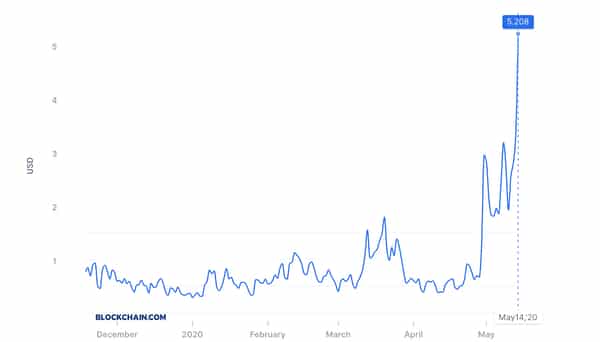
Bitcoin fees have risen this month by 10x from 50 cent to now just above five dollars with bitcoin miners receiving around $1.5 million a day from transaction fees. That’s...
The post Bitcoin Fees Rise to $5 as Blocksize Reaches All Time High appeared first on Trustnodes.
Bitcoin halving is past us and during this time there have been some changes in the network. As expected, the hash rate of the network crashed 40% from the all-time high put on the halving day as smaller and less profitable miners turned off their machines after being unprofitable. A decline in hash rate means […]
Revenue for Bitcoin (BTC) miners plunged 48% a day following the third halving, as the full impact of the periodic supply cut event began to take effect. According to data from crypto company Blockchain, the total value of block subsidies and transaction fees paid to miners crashed to $8.
The King coin's network is maintained by transaction fees and there are two scenarios here - Either the fees have to go up or the block space or the capacity for transactions has to increase.
BitcoThe post Bitcoin halving: Even if 50% of miners shut operation, 'network is still secured' appeared first on AMBCrypto.
The fees that the Ethereum users pay for using the robustness of the network are now bigger than what the network spends to keep the pace. The Tokenanalyst data published by Ankit Chipluncar claims in March 2020 the miners of uncle blocks received 20.
Once set up with a bitcoin or bitcoin cash wallet and some coins, using and sending them is pretty easy. Part of this process involves paying a transaction fee, which is a small amount of coin included in a transaction incentivizing miners to work the tx into a block.
A proposal to burn a portion of fees paid to miners, authored by Vitalik Buterin and Eric Connor, has gained considerable traction in the Ethereum community. The improved efficiency may...The post Ethereum Efficiency Proposal Could Make Token Holders Richer appeared first on Cryptocurrency News.
It has been suggested by BTC.Top CEO Jiang Zhuoer and a cartel of other miners, that a 12.5 percent tax be imposed on Bitcoin Cash (BCH) block rewards for development fees on the protocol. This comes with a threat of orphaned blocks for those who don’t adhere to the payment and an overarching feeling of […]
The post Bitcoin Cash Proposed Miner Tax Could be a Suicidal Move appeared first on BeInCrypto.
The Bitcoin ledger is completing a decade on the 3rd and while it is only 2 days into 2020, the ledger is already setting new records. Bitcoin's hashrate breached its previous high and was recorded toThe post Ethereum miners' earnings 4x BTC miners' via fees in 2019 appeared first on AMBCrypto.
Bitcoin miners are currently earning 12. 5 BTC for each block they mine successfully. The third reward halving will cut down this reward to half to 6. 25 BTC. There are about 5 months left when this event will occur and put a dent in miners’ revenue.
Mining is an essential component for the cryptocurrency industry, though high electricity fees can make turning a profit more difficult in some areas. The process itself is treated the same way as self-employment, by some countries, resulting in taxation of the miners associated with it.
As reported by PressTV, the Iranian news outlet, on November 13th, authorities in Iran are offering bounties to people who expose unauthorized crypto mining operations. The announcement was made by an Energy Ministry’s spokesman at an interview with IRIB News.
Miner fees for many of the leading altcoins are at dangerously low levels. Data shows that the combined revenue generated by those operating the computer systems securing different altcoins was just hundreds of dollars or less over the last 24 hours.
Fees have been rising, despite declining transactions per day, because of a lack of efficient scaling methods. This week, miners voted to increase gas limits by 25%. Overall, fees are lower than during much of 2018.
Miners have expanded the gas limit on Ethereum by 20 percent over the last 10 days, helping address congestion and highlighting an innovative network capability. Over the last quarter, Ethereum has been plagued with congestion as network utilization began to regularly exceed 90 percent.
Etherans are calling on miners to increase ethereum’s version of the blocksize, the gas limit, amid congestion on the network following increased demand. Fees have risen to $0. 075 for a. .
Bitcoin Cash (BCH) and Craig Wright’s Bitcoin SV (BSV) miners receive more than four times less in transaction fees within a year compared to what their progenitor, Bitcoin (BTC), miners’ receive in one day.
Montreal-based technology company, Shakepay recently took to its social media platform in which a comparison in miners’ earnings was revealed. In particular this involves those mining Bitcoin [BTC], Bitcoin Cash [BCH] and Bitcoin SV [BSV], but in the form of transaction fees.
In one day, Bitcoin miners earned up to four times the revenue accrued by their counterparts on the Bitcoin SV and Bitcoin Cash networks combined. Bitcoin is King According to a Friday (August 2, 2019) tweet from “Shakepay,” Bitcoin miners earned $540,000 in transaction fees.
CoinMetrics has released a detailed report about Bitcoin and it’s forks, covering a number of topics from the elimination of OP_RETURN in BSV, to the time taken to rewrite the blocks on a network.
Gominer Token is a Peer-to-Peer token that has a sophisticated level of security for a multi-functional digital currency and for all future use expansion.
The token is created to help our user to interact and expand the way of their earning in Cloud mining.
Bitcoin price regained and held ground above $8000 May 24 as new data showed miner revenues had reached their highest in 10 months. Mining Reverses 2018 Bear Market Lows Data from Blockchain. com confirmed miners’ income as the latest in a series of Bitcoin metrics to turn seriously bullish in recent weeks, with rewards now topping $17.
When considering Bitcoin dominance in terms of market cap and trading volume, spare a thought for the poor miners. The miners of other altcoins, that is, as they share under 10% of the total fees value between them.
Bitcoin’s recent gains of around 25 percent in the last week or so has not only been good for traders and hodlers, but also miners who have managed to cash in on a boost in...
The post Bitcoin’s Mining Fees Mirror Rocketing Price Surge as Miners Cash in appeared first on Ethereum World News.
The incredible price rally which stormed the market during the closing days of the previous week not only sent Bitcoin prices soaring, but also the fees for its miners. In comparison to other top cryptocurrencies, the king coin blew its competitors out of the water.
By CCN: Binance CEO Changpeng Zhao discussed the idea of potentially reorganizing the Bitcoin blockchain. In this vision, the 7,000 BTC recently stolen from the cryptocurrency exchange would be redistributed to miners in the form of fees.
Research has shown that the number of on-chain Bitcoin transactions has risen dramatically throughout 2019, nearing the volume of Bitcoin’s peak in December 2017. Even so, transaction fees are a fraction of what they were around bitcoin’s all-time high, likely due to the continued uptick of SegWit transactions on the network.
Bitcoin Blocks Are Close To Becoming Full Once Again Bitcoin (BTC) blocks seem to be reaching a limit, leading to an increase in the fees that miners take for processing transactions. Since April 2018, the number of transactions in the Bitcoin network has been growing, reaching 452,000 transactions in just a single day a few […]
Bitcoin [BTC] has recorded a successful 2019, with the king coin rallying towards a $6000 valuation. As previously reported, Bitcoin [BTC] had also recorded a six-month high hashrate of $58. 11 million TH/s, which was extremely close to its all-the time high of 61.
Bitcoin miners earned $291 million through ‘block rewards’ in April, marking a 30-percent monthly revenue increase, reports research unit Diar. They collected an additional $14 million with Bitcoin transaction fees, 250 percent more than in March.
By CCN. com: According to blockchain data and CCN/Hacked reporter Greg Thomson, an anonymous miner who embeds the words “Satoshi Nakamoto” into all of the blocks they mine currently controls more than 40% of Bitcoin Cash’s hashrate.
A CCN reader wrote in to ask us to explain why he has 13 payments pending in the Bitcoin blockchain. The answer is simple enough: at any time, the Bitcoin main chain can become congested. The only way to ensure Bitcoin payments arrive in a very timely fashion is to either pay the highest possible fee or use Lightning Network, which is still gaining traction.
In the cryptocurrency world, transaction fees can make or break any project. While some projects try to maintain a zero-fee transaction structure, the vast majority of them tend to charge a small amount for miners to include transactions in blocks.
After a year on its testnet, the VeriBlock blockchain went live yesterday on the Bitcoin mainnet, allowing exchanges, wallet providers, merchants and other crypto businesses to leverage Bitcoin’s robust blockchain security.
It takes an average of $7 million every day to secure the Bitcoin blockchain network, according to Messari. The cryptocurrency data portal published a new screener this Monday which outlined the revenues paid to miners for top proof-of-work coins.
Miners Do Not Agree With JP Morgan Regarding Bitcoin’s Fair Value Of $2,400 Cryptocurrency miners disagree with JP Morgan regarding the proposed “fair value” for Bitcoin close to $2,400. The bank has released this estimation during a report launched last month.
An Ethereum (ETH) user is probably counting his losses as the Ethereum network charged him a staggering fee of over 2100 ETH to send $14 worth of ETH. While this may seem like a mistake, the user’s account is said to be very active and so chances of making such a mistake are really slim.
The crypto industry is abuzz about an extremely generous tip, left to Ethereum miners by an apparently high-rolling developer. Four transactions, all dated Feb. 19 and originating from the same wallet, spent 3,150 ETH in transaction fees.
Bitcoin (BTC) miners and their revenue is hitting a new near 2-year-low. This is very important for the network that is growing and expanding all over the world. One of the first noticeable effects of this revenue drop for miners is that transaction fees are lower. It is becoming very cheap to transact Bitcoin on […]
JPMorgan upgraded Cipher and CleanSpark, and cut targets for MARA, RIOT due to the increased risk of shareholder dilution. Bitcoin miners are increasingly diversifying their operations from hashrate to high-performance computing.
Bitcoin Magazine
Bitcoin-miner Bitmain Faces Federal Investigation Over National Security Issues: Report
Bitmain, the Chinese manufacturer behind many of the world’s Bitcoin miners, has been under US national security scrutiny for potential espionage or sabotage risks, including in Trump family-backed ventures, though the company denies any wrongdoing.
Hive Digital stock jumped by over 500% from its April low to its October high; it pivoted to AI and HPC industries. But its Bitcoin mining revenue is still strong.
Bitcoin crossed a watershed moment in its monetary history on Nov. 17, surpassing 19. 95 million mined coins and pushing the network past 95% of its immutable 21 million supply cap. This leaves the network with less than 1.
Cloud mining beats solo mining as Bitcoin climbs, and GBC Mining offers a $20 bonus plus instant hash power for daily BTC earnings with no hardware needed.
Power markets are starting to price Bitcoin mining that can switch on and off as a grid service. Curtailment remains elevated in regions with high renewable penetration, and short scarcity bursts continue to set value for fast demand reduction, which creates room for load that soaks midday surplus and idles during tight hours.