2025-10-14 10:10 |
When Zap Africa launched a few years ago, it arrived as a tidy, mobile-first answer to a perennial problem in African crypto: how to give everyday users simple access to digital assets without forcing them to hand custody to a centralized exchange.
In July 2025, the startup pushed that promise forward with a major rebrand and a substantial upgrade to its flagship product, Zap Exchange, a move that goes beyond changing colours and logos. It is an attempt to repackage a technical virtue (non-custody) into something that feels safe, fast and familiar for people who mostly use phones and bank transfers to move money.
For anyone watching Nigeria’s fintech and crypto space, Zap’s story matters because it sits at the crossroads of three trends: distrust of custodial platforms following high-profile exchange collapses; the rise of mobile-first, fiat-integrated crypto tools; and the regulatory push to formalize crypto service providers across jurisdictions.
The company, founded by childhood friends Tobi Asu-Johnson (CEO) and Moore Dagogo-Hart (CTO) in 2022, has woven all three into its product, claiming a user base in the tens of thousands and consistent transaction volumes. Those figures, combined with the July rebrand, tell a story of a startup trying to graduate from MVP to mainstream product.
A Rebrand with Purpose, Not Just PolishRebrands can be cosmetic exercises; they’re not, for Zap. The July 2025 refresh introduced a new visual identity and an interface that the company describes as a “control-room” for users; faster logins, saved wallet addresses, token-specific trade history and custom watchlists with real-time price alerts.
Those aren’t trivial tweaks. They are explicit attempts to lower the friction inherent in self-custody: fewer clicks, clearer records, faster re-entry into a trade. For a product that asks users to hold their private keys, friction is the enemy, and cleaner onboarding and session flows are the antidote.
A new UI was shipped alongside performance improvements and a mobile experience tuned for Nigerians who habitually transact on the go. In short, the look and the under-the-hood work arrived together. That combination is precisely what helps a technical product feel less intimidating to first-time users.
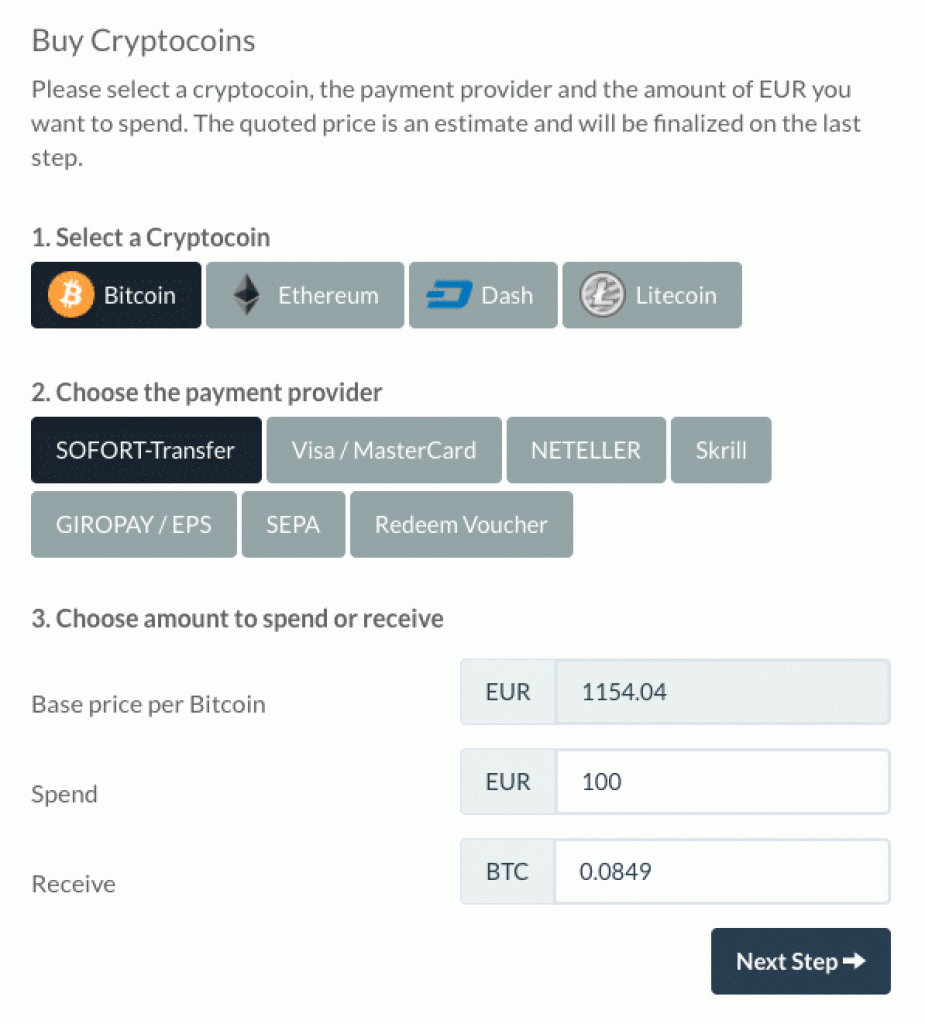
What Zap Actually Offers TodayAt its core, Zap Exchange is non-custodial: the company routes trades and provides rails, but users retain control of their private keys. The exchange supports major assets — BTC, EVM chains, SOL, TRON, and TON — and provides NGN rails so customers can move between naira and crypto using bank transfers today, with card rails coming online.
Zap also launched a Wallet beta in March 2025 as part of a broader product push, and it’s available as native apps on Google Play and the App Store. The platform integrates identity and AML vendors to add legitimacy to what would otherwise be a purely tech proposition.
Operationally, the numbers reported in the press paint a picture of steady early traction: publications cite a user base of around 50,000, monthly transaction volumes over $2 million, and revenue in the $50,000 range. Those figures suggest Zap is past the ‘proof of concept’ stage and into a growth phase that tests everything from compliance and banking partnerships to customer support and education.
Transparent Fee ModelZap’s fee model is straightforward and built for clarity. Trades carry a variable fee that typically sits between 0.5% and 1.5%, with margins and discounts that scale with trading volume and activity. That means casual users pay a modest percentage on each swap, while higher-volume traders can expect better margins.
The team emphasizes fee transparency; fees are shown before a trade is confirmed, and there are clear notes about how on-ramp/off-ramp costs (bank transfer vs. card, for example) can affect the final price. For a startup balancing non-custodial UX with the need to generate revenue, this fee band is competitive in the regional market and helps explain the platform’s steady monthly receipts.
Focus on User SecurityZap’s defense against the centralized-exchange risk is straightforward: do not custody assets. That design choice removes a large class of counterparty exposure, but it also demands ironed-out user education, clear recovery paths, and steady UX choices that prevent phishing and seed loss.
Although Zap itself does not custody user funds, the company recognizes that security still has to be operationalized through tooling and education. To that end, Zap has conducted multiple security audits (including VAPT certification) and has pointed to third-party reviews of its infrastructure.
The product also includes practical user protections: explicit seed-backup prompts, session management to reduce accidental exposure from lost devices, and compatibility with standard wallet-security practices. Still, the non-custodial model shifts the last line of defense onto users, which is why Zap pairs technical safeguards with in-app education and customer support aimed at preventing phishing and other human errors.
Compliance and the Regulatory TightropeOn compliance, Zap took an unusual route for a Nigerian startup by securing an EU VASP license in Lithuania and raising a $300k pre-seed round in 2024, moves that open doors for bank integrations and show investors the company is serious about operating inside regulated rails.
Moreover, Zap has taken a pragmatic, vendor-driven approach. The platform uses established providers, Sumsub for identity verification, Smile ID for local biometric and liveness checks, and AMLbot for transaction monitoring and suspicious-activity screening.
That stack gives Zap the tools to run a robust KYC process without building the entire system in-house, which is an important reason banks and payment partners have been willing to engage. Zap positions KYC as a trade-off: friction at sign-up for smoother fiat rails and stronger institutional partnerships —a sensible path for a VASP that wants to scale in regulated markets.
Still, the regulatory landscape across Africa is uneven. An EU license and local registration make bank deals easier, but country-by-country compliance will be necessary as Zap targets expansion beyond Nigeria. Expect local licenses, new payment integrations and more rigorous audit transparency to be on the runway for the next 12–18 months.
Strengths, Headwinds and the Road AheadZap’s primary strength is product focus: the team has built a mobile-first, non-custodial flow that tries to feel as frictionless as a custodial app. That’s a high-value proposition in regions where trust in intermediaries is low. The rebrand is a marketing and product milestone; it makes the tech legible to mainstream users.
But there are real execution risks. Non-custody moves responsibility to users, which increases the need for education, customer support and foolproof UX. Competition is intensifying: larger exchanges with deep pockets can subsidize onboarding, while other Web3 projects chase better UX and liquidity.
Zap Exchange is currently raising a $1.5M seed round to fund product upgrades, including a planned crypto payment card, and to accelerate expansion and partner integrations. If the company converts product polish into higher retention and broader fiat utility, it can carve out a durable niche. If not, the race will get expensive.
A softer but real challenge for Zap is the onboarding friction created by robust KYC and the responsibilities of self-custody. Customers often expect instant, app-store-like onboarding; instead, Zap asks for identity checks and attention to wallet safety.
The company is aware of this trade-off and has been beefing up customer support and educational flows to reduce drop-off. How well Zap can lower that friction without sacrificing compliance will be a key barometer of the company’s ability to expand beyond early adopters.
Final WordZap Africa’s rebrand is more than a logo swap. It is a public signal that a Nigerian startup wants to translate a principled, technically conservative stance on custody into a product that mainstream users can trust and use day to day.
The coming months will test whether cleaner UX and stronger rails can overcome the twin challenges of user education and competitive pressure. For now, Zap looks like a credible bet on a middle path between TradFi convenience and Web3 sovereignty, and that alone makes it a company worth watching in Africa’s fast-moving crypto story.
origin »Bitcoin price in Telegram @btc_price_every_hour
SherLOCK Security (LOCK) на Currencies.ru


|