Bitcoin expects to undergo a significant rally as a top economist predicts an inflation bias after 12-18 months.
The analogy comes after demand for inflation-protected bonds spike in the US, showing investors expect consumer prices to increase in the future.
Bitcoin has shown higher adoption in countries with a higher inflation rate, a narrative that prompts some to see it as an alternative to fiat money.
It has been a boring couple of weeks of Bitcoin as its price remains trapped inside a $300 trading range.
But the “scarce” cryptocurrency could avoid these short-term setbacks. Instead, it could rally on a more extended timeframe – as it has done for a majority of its 11-year lifetime. Once again, it is the fears of inflation caused by central banks’ endless money printing that may end up driving its price higher.
Inflation Fears High
Recent data shows that. EPFR, an agency that tracks capital flows across institutional investment portfolios, found that investors injected more than $5 billion into funds investing in Treasury Inflation-Protected Securities over the four weeks ending July 8. Also known as Tips, the securities protect portfolios from inflation.
The yields on 30-year Tips are now 0.26 percent below zero, according to Tradeweb data. Meanwhile, five and ten years Tip yields have also crashed to the levels last seen in 2012 and 2013. A falling return represents a higher demand for Tips.
It, therefore, marks the first time since the beginning of the COVID pandemic that investors have illustrated their fears of rising consumer prices.
Bitcoin Demand
People in the Bitcoin and gold industry have mainly been vocal about the issue. They note that the Federal Reserve’s decision to inject $2.6 trillion to aid an ailing US economy would lead to massive inflation in the coming years.
Paul Tudor Jones, a billionaire hedge fund manager, acknowledged the same in his investor note from May 2020. The veteran also noted that young assets like Bitcoin could protect people from the aftermath of a devaluing fiat currency. He allocated up to 3 percent of his $22 billion-portfolio into the cryptocurrency.
Steven Blitz, the chief economist at TS Lombard, also sees an inflation spike when the US economy recovers from its lockdown-induced slumber. The Federal Reserve’s stimulus program, as well as an unprecedented increase in the government’s spendings, could push up Tips prices.
“I do not expect inflation for the next 12-18 months,” Blitz added. “After that, I could see the economy having a higher inflation bias.”
He also noted that rising consumer prices would also erode the value of government bonds. They are already yielding lower returns.
Therefore, investors looking for better returns could continue seeking profits from risk-on markets. It may end up benefitting both Bitcoin and stocks in the long-term.
Bitcoin price rangebound between $9,100 and $9,400. Source: TradingView.com
The cryptocurrency has already surged by more than 150 percent against falling sovereign yields.
Bitcoin so far has seen higher demand in countries hit by higher- or hyperinflation. Venezuela, Lebanon, Turkey, Iran, and Zimbabwe are the prime case-studies where people have started opting for non-sovereign cryptocurrencies over their devalued fiat. origin »
Bitcoin's sensitivity to inflation data underscores its role as a speculative asset, influencing investor strategies amid policy shifts.
The post Bitcoin briefly surges past $112,000 following 3% inflation report appeared first on Crypto Briefing.
U.S. inflation rose just 0.1% in May, easing market fears but staying above the Fed's 2% target.
Technical analysis showed that Bitcoin was likely to leap higher.
The recent inflation news wThe post Bitcoin set for explosive growth as inflation cools - $200k in sight? appeared first on AMBCrypto.
Bitcoin reacts positively to April’s CPI report, showing stable inflation at 2.3%. With cooling inflation, the Fed may cut interest rates soon, boosting crypto market sentiment.
The post Bitcoin Price Reacts as US CPI Data Shows Inflation Cooled to 2.3% in April appeared first on BeInCrypto.
Bitcoin and Ethereum prices rise as US inflation drops to 2. 4%. Lower-than-expected inflation data boosts market optimism. Trump’s delay of tariff hikes eases trade-related uncertainties.
US inflation data has injected renewed optimism into the Bitcoin and broader cryptocurrency markets. In January, the Personal Consumption Expenditures (PCE) inflation—the Federal Reserve’s preferred measure—fell to 2.
Rising inflation pressures may delay interest rate cuts, impacting crypto market stability and investor sentiment in the near term.
The post Bitcoin drops on hotter-than-expected inflation reports appeared first on Crypto Briefing.
Bitcoin traded near $98,000 Wednesday after US November inflation data aligned with forecasts. The annual inflation rate reached 2. 7%, matching consensus up 0. 1%, while core inflation held at 3.
Powell admits difficulty in stabilizing inflation at 2%, citing its volatile nature.
Kiyosaki recommends gold, silver, and Bitcoin as hedges against inflation and fiat devaluation.
In a receThe post Bitcoin 'for you and your family' to stop inflation? This man says yes... appeared first on AMBCrypto.
Amidst a 68.5% inflation rate in Turkey, Bitcoin nears all-time highs as citizens turn to cryptocurrencies, with the government poised to implement stringent regulations.
The post Bitcoin Nears All-Time Highs in Turkey as Inflation Climbs 68.5% appeared first on BeInCrypto.
Despite bitcoin’s tumultuous year, the world’s largest digital asset proved to be a reliable hedge against inflation. And a number of Liberal MPs own it.
Is Bitcoin a viable investment option as a hedge against inflation and currency debasement? Explore both sides of the debate
The post Jay Powell May Not Understand Inflation, But is Bitcoin the Answer? appeared first on BeInCrypto.
The price of bitcoin is gradually recovering amid new signs of slowing inflation in the United States. Last week, the cryptocurrency market experienced the pressure associated with the bankruptcy of the FTX exchange — an event comparable to the Mt.
Growing economic instability, especially in the United Kingdom, has seen investors swarming back to Bitcoin as an inflation hedge.
The post Embattled Markets Revive Bitcoin Inflation Hedge Argument appeared first on BeInCrypto.
Bitcoin and Ethereum were hit hard as the inflation data dropped. U.S. Inflation Print Surpasses Expectations U.S. inflation has decreased for a second consecutive month. The Bureau of Labor Statistics...
The consumer price index report published by the Department of Labor shows that United States inflation dropped to 8.5% in July, marking a sharper fall from 9.1%.
The post Bitcoin and Altcoins Spike as US Inflation Drops appeared first on BeInCrypto.
Bitcoin holds onto $19,000 as investors remain cautious of inflation numbers. The price may…
The post Bitcoin steady as inflation data nears – Major turning point or further crash? appeared first on CoinJournal.
The long-standing claim that bitcoin is a hedge against inflation has come to a fork in the road as inflation is soaring, but the bitcoin price is not.
Inflation data shows a 106% increase in fuel oil year-over-year with an unexpected 40-year high Consumer Price Index report of 8.6% as bitcoin dips to $29,500.
The price of Bitcoin rose after March CPI data confirmed that inflation in the United States continues to increase, hitting the highest level in 40 years.
The post Bitcoin sees positive reaction as inflation hits 8.
The price of Bitcoin rose after March CPI data confirmed that inflation in the United States continues to increase, hitting the highest level in 40 years.
The post Bitcoin has initial positive reaction as inflation hits 8.
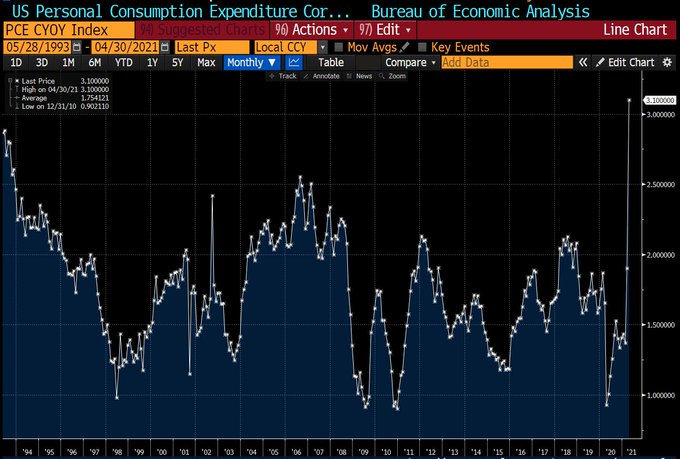
The U. S. Personal Consumption Expenditure (PCE) core price index has soared to its highest level since 1992, stoking inflation fears. Some say Bitcoin, with its fixed supply of 21 million tokens, will resist inflation.
A dramatically heightened inflation makes up the strongest bullish case for Bitcoin, a cryptocurrency that poses itself as the safest insurance against a potential rise in consumer prices and fiat devaluation.
The line of sight on U.S. inflation is anything but clear after the Labor Department reports the CPI's smallest yearly gain since 2015. So what does it mean for bitcoin?
The U. S. Federal Reserve has announced a significant policy change to push up inflation. Bitcoin is set to greatly benefit from this policy change. Not only the price of bitcoin could surge past $500K, but a number of companies have also begun moving their reserves into the cryptocurrency to hedge against higher inflation.
While fears of a “great monetary inflation” have driven the recent bitcoin narrative, other aspects like censorship resistance and peaceful protest matter just as much.
On Monday, the latest Bitcoin block reward halving finally arrived, decreasing the inflation rate of the BTC monetary base by 50 percent to ~1. 6 percent — under the target inflation rate of fiat currencies and under the growth of the above-ground supply of gold.
When Satoshi Nakamoto invented Bitcoin, the creator designed the protocol to be an inflationary currency, one that is predictable as bitcoin’s inflation always decreases every four years. Today, 77 days before the reward halving, BTC’s inflation rate is around 3.
After Bitcoin’s halving event in May, its inflation rate will drop to just 1. 8% annually. That puts it far lower than most inflation targets by central banks. Bitcoin (BTC) has often been discussed as a tool to combat inflation.
The overall inflation is up by 55 percent, with the cost of education, medical care, and housing all on the rise. Bitcoin is considered as the alternative or people and a better store of value due to its anti-inflationary feature.
The Philippines is experiencing an inflation crisis. Yet virtually its entire population of 106 million people are unaware of and reject the notion that Bitcoin (BTC) and cryptocurrencies give them a payment solution and store of value.
The disclosure brings to question whether state-sponsored or organized hackers would have succeeded in exploiting the Bitcoin software bugs had they known about them to threaten what was thought to be an impregnable blockchain network.
Respected economist Professor Steve Hanke has chanted down central banks. While Hanke doesn’t tout cryptocurrency as an alternative, he does say that the world needs fewer central banks because these government-controlled entities are messing up economies and abusing monetary policy, while fueling inflation and loss of wealth.
Discover why ZKP is standing out as a top presale crypto, with privacy + verification technology that supports secure, verifiable AI compute as its presale auction goes live.
A staged fake-delivery encounter in San Francisco’s Mission Dolores district escalated into one of the city’s largest known individual crypto thefts, after a disguised assailant subdued a resident and escaped with assets worth $11 million, alongside the victim’s phone and laptop.
Best Wallet Token nears its presale finale with $17M raised, live app utility, and strong staking rewards—making BEST a leading contender for the next 100x crypto.
Hyperliquid displays a Head and Shoulder pattern of HYPE token, which indicates a significant price change. The $35.5 neckline is crucial with a target of $12.
In a recent financial statement on Circle’s (CRCL) third-quarter (Q3) performance, the stablecoin giant saw tremendous increase in key metrics, exceeding Wall Street estimates. Circle’s Financial Disclosures According to the financial disclosures made public by the firm on Wednesday, Circle’s Reserve Income surged to $711 million, marking a substantial 60% year-over-year increase, primarily fueled by […]
According to a recent report by Bloomberg, the cybersecurity arm of China has openly accused the US government of orchestrating the theft of approximately $13 billion in Bitcoin (BTC), adding tension to the ongoing cyber relations between the two nations.