2025-11-1 21:00 |
Solana (SOL) processes approximately 70 million transactions per day and recorded over $143 billion in monthly DEX volume as of Oct. 30, according to DefiLlama.
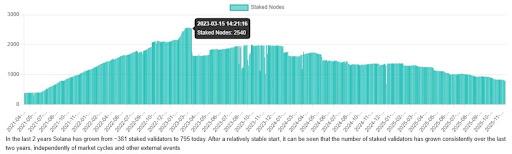
The network operates with 1,295 consensus validators across 40 countries, and a Nakamoto Coefficient of 20, according to the Foundation’s June 2025 Network Health Report. Production throughput runs at approximately 1,100 transactions per second.
The throughput enhancements followed a five-hour outage in February 2024. The event prompted the Solana ecosystem to introduce measures such as stake-weighted Quality of Service (QoS), tests with the Firedancer client in hybrid form, and adjusted validator economics through priority fee routing.
Transaction volume and execution modelDeFiLlama data shows Solana’s spot monthly DEX volume at roughly $143 billion as of Oct. 30. Ethereum’s volume in the same period reached nearly $138 billion.
However, Ethereum’s base layer processes fewer than 1.2 million transactions per day, while Solana processes over 70 million.
Ethereum routes most DeFi activity to layer-2 rollups that batch transactions before settling on the base layer. Solana executes all transactions on a single layer.
Jake Kennis, senior research analyst at Nansen, attributes Solana’s activity to infrastructure and market catalysts.
In a note, he stated:
“Solana’s runtime did the hard work first: Sealevel’s parallel execution, sub-second blocks, stake-weighted QoS over QUIC kept latency low and fees stable under load. That design avoided rollup-style fragmentation and delivered ‘one venue, one wallet, one mempool’ trading.”
Market catalysts included Jito airdrops in 2023, Jupiter airdrops in 2024, memecoin activity via Pump.fun, and wallet integrations from Phantom, Jupiter, and Uniswap.
Fee structure and congestion responseSolana charges a fixed base fee of 0.000005 SOL per signature plus optional priority fees. During the early 2024 memecoin surge, transactions failed despite users paying priority fees.
Version 1.18 implemented stake-weighted Quality of Service, allocating block space proportional to validator stake. Messari’s report for the second quarter of last year documented congestion reduction following SQoS deployment.
The fee mechanism remains local rather than global. Helius and Eclipse Labs documentation explain that Solana’s parallel transaction scheduler doesn’t uniformly price inclusion across all validators based on priority fees paid.
Users can overpay or underpay relative to the actual network load. SIMD-96 routes all priority fees to validators, changing revenue distribution but not the local pricing structure.
Additionally, Jito’s July 2025 TipRouter upgrade allows validators to distribute priority fees to stakers alongside protocol-defined staking rewards.
The Foundation’s June 2025 report indicates that validator total revenue (REV) is increasing, while breakeven stake requirements are declining. Most stake previously ran on Jito’s MEV-auction infrastructure, concentrating on extraction.
SIMD-96 and client diversity are redistributing this surplus. Kennis noted:
“Fewer single-stack dependencies mean fairer execution. Diversification may redistribute surplus: users gain via tighter spreads, LPs see faster arbitrage, and validator margins compress as tip revenue competes down.”
Jupiter Ultra V3 and similar aggregators reduce harmful MEV while preserving arbitrage opportunities.
Client implementation and outage historyThe Feb. 6, 2024, outage lasted five hours and originated from a bug in the Just-in-Time compiler used by the Agave client.
All validators ran either Agave or Jito’s fork, requiring a coordinated network restart. The Foundation’s post-mortem documented the failure.
Firedancer, developed by Jump Crypto in C++, entered testing in hybrid “Frankendancer” mode, where Firedancer handles consensus and networking while Agave manages execution.
The Foundation’s June 2025 report notes dozens of validators running Frankendancer. Lab tests demonstrated 1 million TPS.
Two additional clients are under development, Mithril in Go and Sig in Zig.
Kennis explained:
“Client diversity hardens the network and opens performance headroom. Firedancer and Frankendancer have shown ~1M TPS in tests; real-world gains depend on rollout. Even with broader validator geography, QUIC and SW-QoS sustain consistent throughput.”
Electric Capital’s 2024 Developer Report ranked Solana first in terms of new developer additions, with approximately 7,625 new developers that year.
Ethereum retains the most extensive absolute developer base. Solana Mobile Stack integrates wallet, security, and browser functionality into Android hardware. Helium migrated its decentralized wireless network to Solana for on-chain settlement.
Ethereum comparisonEthereum’s base layer processed fewer than 1.2 million transactions per day in recent periods while achieving comparable DEX volume to Solana.
The difference is transaction compression through rollups. Arbitrum, Base, and Optimism batch hundreds of transactions into a single base-layer submission.
Token Terminal data shows that Ethereum’s EIP-1559 base fee declined in 2025 as Layer 2 activity reduced demand on the base layer.
Solana’s fixed base fee, combined with priority fees, generates lower per-transaction revenue but higher transaction counts. Total fee revenue depends on sustained transaction volume.
Solana’s monolithic model avoids cross-rollup bridging and maintains unified liquidity. The trade-off is higher validator hardware requirements and tighter coordination needs.
Ethereum’s rollup model distributes operational complexity to Layer 2 operators, but it fragments liquidity and introduces trust assumptions related to sequencers.
Monitoring pointsFiredancer adoption rate will determine whether Solana achieves client diversity before the next network stress event. Full Firedancer deployment could enable higher throughput if validators migrate from Agave.
Fee-market improvements through SIMDs should tighten the correlation between priority fees paid and the speed of transaction inclusion.
SIMD-96’s fee routing to validators combined with client diversity will test whether validator margins compress as Kennis predicts, or whether throughput gains offset margin pressure.
MEV economics post-diversification will show whether aggregators successfully reduce harmful extraction while maintaining arbitrage efficiency.
If validator tip revenue becomes more competitive across multiple client implementations, staker APRs may stabilize at lower levels.
The data will show whether Solana’s parallel execution, sub-second finality, and unified liquidity model can scale without the multi-layer fragmentation Ethereum adopted, or whether base-layer coordination constraints eventually force similar architectural changes.
The post 70M daily transactions, $143B volume: How Solana won DeFi’s throughput race appeared first on CryptoSlate.
origin »Bitcoin price in Telegram @btc_price_every_hour
Santiment Network Token (SAN) на Currencies.ru


|