If you’ve been following crypto over the past week, you likely have heard it all about Ethereum and DeFi.
The use of these two words in the industry has become incessant as market trends have shifted in favor of the two.
Tahar Zafar, a cryptocurrency analyst, shared the below table illustrating these trends perfectly. It shows that as of June 18th, Ethereum-based tokens such as Aave’s LEND, Kyber Network’s KNC, and Bancor’s BNT, were outpacing Bitcoin.
Bitcoin vs. DeFi-focused tokens over the past 90 days. Data current as of Jun. 18. Image from Taha Zafar
Even Ethereum, which most often moves directly in tandem with BTC, has been slightly outperforming the market leader.
Yet a crypto research firm says that Ethereum DeFi will eventually see a correction and return to more reasonable levels.
Ethereum DeFi Will Eventually Return to Earth
DeFi-related tokens have shot higher by dozens and hundreds of percent over recent months as outlined above. This has coincided with an exponential increase in the economic firepower of the DeFi ecosystem.
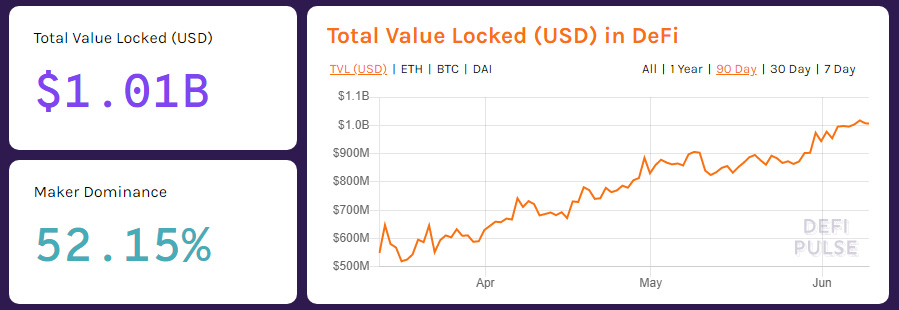
DeFiPulse reports that the value of cryptocurrency locked in DeFi applications has reached $1.6 billion. This is three times that was seen in March and more than 60% higher than this metric was 10 days ago.
According to Weiss Crypto, DeFi may be exciting but it may soon see a correction to normality:
“DeFi is one of the most exciting things going on in crypto right now, but the idea that this sector will decouple from the rest of the market is ludicrous. Eventually, the mania will end, and DeFi will trade in line with the rest of the market.”
#DeFi is one of the most exciting things going on in the #crypto right now, but the idea that this sector will decouple from the rest of the market is ludicrous. Eventually, the mania will end, and DeFi will trade in line with the rest of the market.
— Weiss Crypto Ratings (@WeissCrypto) June 24, 2020
DeFi Is Facing Down a Number of Roadblocks
Supporting Weiss Crypto’s expectations of a market correction is the roadblocks DeFi is facing down.
Despite moves to increase the gas each Ethereum block can have, transaction fees are still relatively high. It can cost dozens of dollars to send a DeFi transaction, some on Twitter have said over recent days.
These high fees prevent smaller holders from participating in many parts of the Ethereum ecosystem. This should depress the rate at which DeFi tokens can rally.
Also, DeFi is subject to medium-term “latency” issues, according to Kyle Samani of Multicoin Capital.
Per previous reports from Bitcoinist, Samani explained that DeFi is unlikely to succeed with Ethereum in its current state:
“You just can’t build global scale trading systems for lots of users on POW chains. It just doesn’t work. High latency –> all kinds of negative second order effects. So I think for now we are near a plateau for DeFi – measured in ETH terms (not USD) – until the core latency problems are solved.”
This was in reference to the blockchain’s relatively long block times compared to the light-speed nature of the Internet. He’s saying that you can’t build full-scale financial applications when it takes ~13-14 seconds for any exchange of information/value to take place.
Featured Image from Shutterstock
Price tags: ethusd, ethbtc
Charts from TradingView.com
Ethereum DeFi May be Exciting But the "Mania Will End": Research Firm origin »
The DeFi market cap has doubled within a span of two months according to analytics firms', DeFi Pulse, and DeFiMarketCap. However, the two entities differ in the analytics that they provide. DeFi Pulse focuses on the exact total value locked (TVL) within this upcoming market.
In a press release issued on June 4, 2020, decentralized finance (DeFi) platform crypto interest-earning platform Celsius Network announced that it had surpassed over $1 billion in total cryptocurrency deposits in less than two years after launch its mobile app.
The crypto industry has long been engaged in a debate regarding whether or not the merits of Centralized Finance (CeFi) outweigh those of Decentralized Finance (DeFi).
The post DeFi vs CeFi: Two industry leaders to square off in debate during BlockDown 2020 appeared first on CryptoSlate.
The Aave protocol has introduced Uniswap tokens as a collateral form, which opens the door to the somewhat risky practice of leveraged liquidity pools on the exchange.
According to official reports, the two companies joined the council alongside independent block producers, EOS Nation and EOS Cannon, to provide oversight over approval of contracts and amendments made on smart contracts on the EOSDT stablecoin blockchain.
One of the most hyped aspects of Ethereum’s ecosystem, decentralized finance (DeFi), has been under the microscope over the past week after a double-whammy hack, with the same underlying exploit being used to steal assets from two DeFi platforms.
According to Zerion CEO Evgeny Yurtaev there are two major issues in the current crypto space. Primarily, although protocols are decentralized many access points to the system, like exchanges, are still centralized.
Zilliqa, a smart contracts platform, has been following Ethereum’s missteps every since CryptoKitties brought the number two network to a halt in 2017. Now, with DeFi’s future in question, can Zilliqa pick...The post Has Zilliqa Built a Better Ethereum Yet? appeared first on Crypto Briefing.
It’s been a crazy past 24 hours for users of decentralized finance, also known as “DeFi. ” Over this time, devious Ethereum users managed to steal over $25 million worth of cryptocurrency from two separate protocols.
Ethereum’s hashrate has not moved at all during the extraordinary events of the past two months even as price volatility led to utter chaos in some defi dapps. You all...
The post Ethereum’s Static Hashrate Puzzles Amid Price Volatility appeared first on Trustnodes.
A DeFi professional describes life under quarantine in COVID-19's epicenter. When the next crisis comes, he says, blockchain tech will be ready to help.
MakerDAO (MKR), an Ethereum-powered lending ecosystem has announced that it will carry out an MKR governance token auction in two days, to off-set the $4 million bad debt in its ecosystem brought about by the massive crash in the price of ether (ETH), reports TheBlock on March 12, 2020.
To answer the problem of slow adoption, an increasing number of companies have put their focus on bringing cross-chain liquidity to DeFi. Ren Protocol and Provable Things are two notable...The post Cross-Chain Liquidity a Major Movement in DeFi appeared first on Crypto Briefing.
The Singapore-registered crypto exchange has partnered with Nervos in this project as its technical development partner. Together, the two provide a regulatory friendly ecosystem for DeFi’s offering financial services like lending, decentralized exchange, payments and asset tokenization based on blockchain networks.
Synthetix, one of the largest DeFi protocols, has announced an initiative that provides an additional reward to good actors for providing liquidity to the ecosystem and assuming risk. Two million...The post Synthetix to Reward Risk-Bearing Stakers in New Upgrade appeared first on Crypto Briefing.
Two recent flash loans on the defi platform Bzx have started a fierce debate about the subject of using uncollateralized loans in a quick trade. Essentially these flash loans are providing people with the ability to borrow crypto without relinquishing any collateral.
DeFi protocols are swelling, with more funds than ever locked in smart contracts. But two recent exploits have highlighted their vulnerabilities—leading critics to suggest they are not as decentralized as they might appear to be.
The crypto industry has been wrapped up in the first two major exploits of decentralized finance this week. The decriers are having a field day but the outcome may actually be bullish for Ethereum.
Ethereum has been on a roll lately since it continues reaching new yearly highs outperforming some of the top cryptocurrencies by market cap. Despite the bull rally seen over the last two months, some argue that ETH is still in a bear market.
In December, we invited two fund managers, both long bitcoin and other crypto assets, for a CoinDesk Research webinar on lending and staking. Jordan Clifford of Scalar Capital and Kyle Samani of Multicoin Capital joined us to discuss how they evaluate risk and returns in crypto lending and staking, what crypto assets' risk-free rate might look like, and what DeFi needs to do to attract investors and new users.
As decentralized finance gains steam how much of it will depend on Ethereum? Well, it depends on how long Ethereum 2. 0 takes to launch. DeFi’s Dominance The number two blockchain hosts the largest number of developers, and thus reports the most activity, according to data from August 2019.
The amount of Ethereum locked in Decentralized Finance (DeFi) has hit an all-time-high after one of the most explosive months for deposits on record and is now up 22,400 percent since December 2017.
It has been a grim end to the week for Ethereum. The world’s number two crypto asset has held up resiliently for most of this month while Bitcoin has been eroded. That resilience ended a few hours ago when ETH prices collapsed by 9 percent.
Decentralized finance and gaming are often mentioned as the two most dominant use cases for public chain dApps. While previously thought to be close, new data suggests DeFi volume had been significantly underreported.
The decentralized applications (dApps) space tends to be dominated by two categories, DeFi and gaming. This is true if you look at the major blockchains like Ethereum, EOS or Tron. However, aggregator site app.
Binance has announced that in two days (August 28) they will be launching lending services for Binance Coin (BNB) and Tether (USDT), August 26, 2019. Lending and borrowing have become the top crypto use case in 2019, with DeFi on smart contract platforms – especially Ethereum – popping significantly.
The narrative of ETH as the building blocks of crypto finance has come to fruition over the last two years. Bitcoin maximalists and proponents of competitors like EOS, TRON, and Cardano continuously criticize Ethereum and claim the success of DeFi is short term and will pop like the ICO bubble.
Helis Network closes seed round to build decentralized finance ecosystem » CryptoNinjas
Helis Network, an enterprise protocol for decentralized finance (DeFi), today confirmed the closing of its seed round for USD $500K.
As anxiety grows around every new twist and turn in the ongoing QuadrigaCX drama, along with extensive QuadrigaCX media coverage, Canada’s mainstream media has been calling on the government to bring in better oversight and regulation of cryptocurrency businesses, especially cryptocurrency exchanges.
Weiss Crypto has spoken out about Cardano’s drive to achieve regulatory approval for its ADA token, and the firm does not approve.
The post Cardano’s Regulatory Compliance is ‘Bad Idea All Round’ Says Weiss Crypto appeared first on BeInCrypto.
Aside from Bitcoin, Cardano (ADA) has rapidly become one of the most popular cryptocurrencies over recent weeks by investors and traders alike. The prominent altcoin, which has re-entered the top-10, has recently been subject to a strong boost.
ChainLink appears to have impressed long-standing investment ratings service Weiss. The company’s cryptocurrency-focused division has been relentlessly shilling the project over the last week or so.
Against the background of aggressive moves of cryptoexchanges tokens, the “old” top coins began to dim. Their creators are beginning to worry and take steps to keep their reputation at a good level.